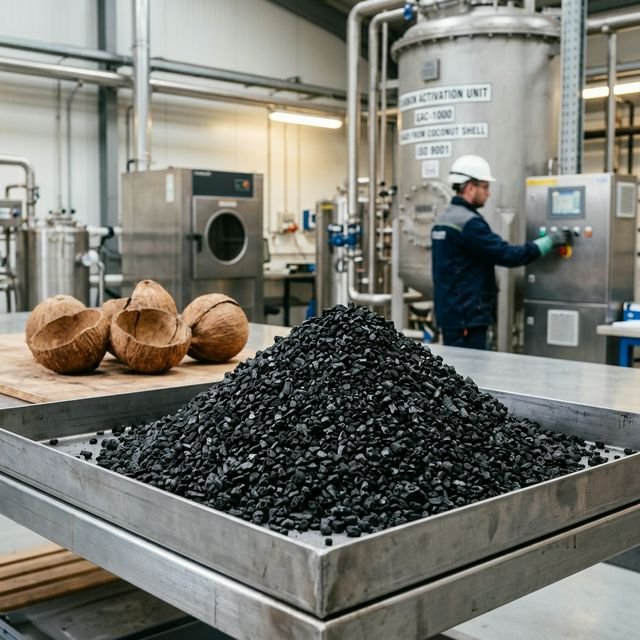
Raw Material Selection: The Foundation of Quality
High-quality coconut activated carbon starts with fully mature, dried coconut shells sourced from tropical coastal plantations. Younger shells have thinner cell walls and higher volatile matter content, leading to softer carbon that degrades during filtration.
Selected shells undergo controlled carbonization in oxygen-deprived pit or rotary kilns at 400°C–500°C, yielding clean, high-density coconut charcoal with low volatile impurities and fixed carbon content above 70%.
Thermal Steam Activation Process
The carbonized char is conveyed into multi-hearth or direct-fired rotary activation kilns where superheated steam is injected at 900°C–1050°C. The water vapor oxidizes interior carbon atoms, carving out millions of sub-nanometer micropores (less than 2 nm diameter) that give activated carbon its extraordinary adsorption capacity.
By precisely modulating residence time inside the activation kiln, different iodine value grades are achieved for different applications.
- Standard Grade (900–1000 mg/g): Ideal for municipal tap water, chlorine dechlorination, and general industrial filtration.
- High Activity Grade (1100–1250 mg/g): For gold CIP/CIL recovery circuits, ultra-pure electronics rinse water, and catalyst support applications.
Screening and Quality Assurance
After activation, the carbon is dedusted, crushed, and vibratory-screened into standard US Mesh sizes such as 4×8, 8×16, 8×30, 12×40, or 20×50 mesh.
Every batch undergoes rigorous testing before dispatch:
- ASTM D4607 — Iodine Number
- ASTM D3802 — Ball-Pan Hardness (typically above 98%)
- Moisture content verification
Packaging and Export
Finished carbon is packed in palletized 25 kg multi-wall kraft bags or 500 kg bulk super sacks, sealed to prevent moisture pickup during international ocean freight. All shipments include a Certificate of Analysis (COA) confirming compliance with ASTM and AWWA standards.